
11 Unique Ways Actors Are Using AI to Advance Their Career (Prompts Included)

Many actors fall into one of two camps. They’re either completely ignoring AI or they’re low-key terrified it’s coming for their job.
Here’s the thing, though…there’s a third option.
A growing number of working actors are quietly using AI tools to save time, sharpen their craft, and get more done between auditions. Not to replace their talent. Just to work smarter.
This post breaks down 11 practical ways actors are using AI right now, with real prompts you can steal today.
Why Actors Are Starting to Use AI Tools
Acting is a hustle. Between auditions, self-tapes, classes, day jobs, and networking, there so much to do, so little time.
AI tools don’t make you a better actor on their own. But they can clear the mental clutter so you can focus on the work that actually matters.
Think of them like a research assistant, a writing partner, and a sounding board, all in one, not as a replacement for actors.
Never annoyed by your questions. Tools like ChatGPT, Claude, and Gemini are the most accessible starting points, and you don’t need to pay for anything fancy to get real value out of them.
There are many free AI tools for actors. Here’s what actors are actually doing with them.
11 Ways Actors Are Using AI Right Now
1. Breaking Down Scripts and Finding Subtext
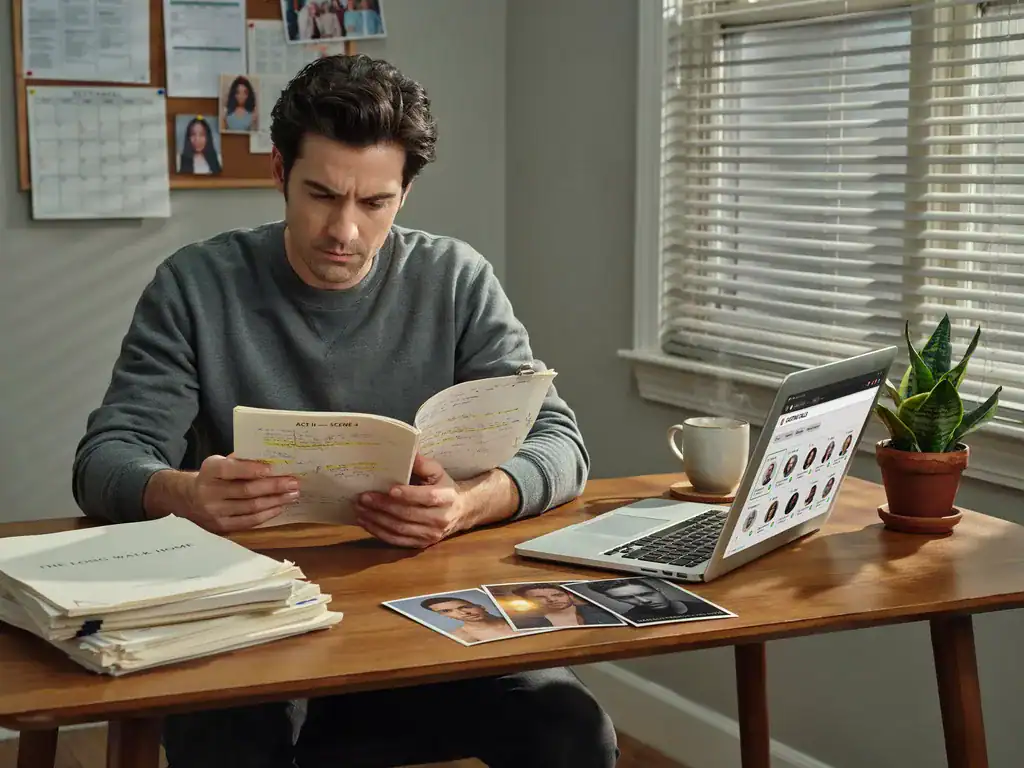
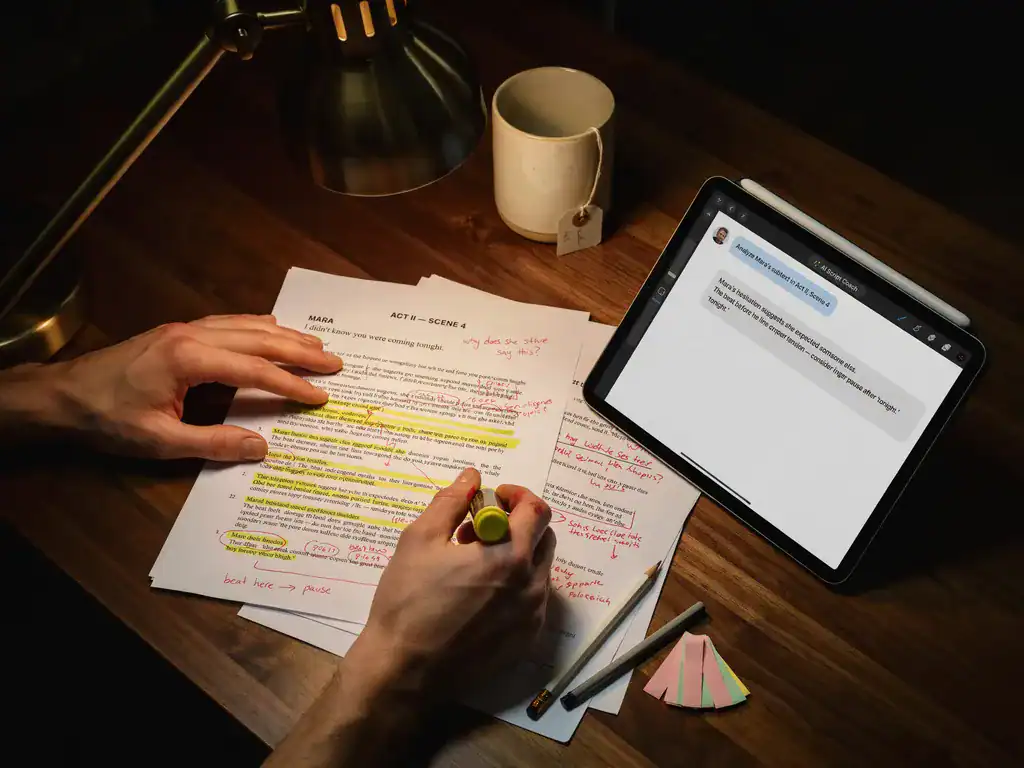
This is one of the most underrated uses of AI for actors. You paste in a scene, and you ask the tool to help you identify what’s really going on beneath the surface, the power dynamics, what each character actually wants, what they’re not saying out loud.
It won’t replace a good director or a sharp acting coach. But as a first pass? It’s genuinely useful, especially when you’ve got sides due in two hours and no time to sit with them.
Try this prompt: “Here’s a scene from [play/script]. Analyze the subtext between the two characters. What does each character actually want, and what are they avoiding saying directly?”
2. Building Character Backstories Fast
Most actors know they should build a rich backstory for every character they play. Most actors also don’t have three hours to do it for a two-line co-star role.
AI can help you sketch out a believable history quickly, one you can then filter through your own instincts and choices.
Give it the character’s name, age, the world of the play or show, and a few key facts from the script. Then ask it to fill in the blanks. You’ll get a starting point you can argue with, which is often more useful than staring at a blank page.
Try this prompt: “I’m playing a 45-year-old detective in a noir crime drama set in 1950s Chicago. Based on those details, help me build a character backstory including childhood, key life events, and what drives him.”
3. Writing Cold Emails to Agents
Agent outreach is one of the most awkward parts of being an actor. You know you need to do it. You also know that most cold emails get deleted in seconds.
AI can help you write something that sounds like a real human wrote it, not a template, not a desperate plea.
Give it context: your experience level, your type, your recent credits, the agency you’re targeting, and why you’re a fit.
Ask it to draft a short, confident cold email. Then rewrite it in your own voice. Use it as a scaffold, not a finished product.
Try this prompt: “Help me write a cold email to a mid-size theatrical agency. I’m an early-career actor, I’ve done two indie films and regional theatre. I want to sound confident but not arrogant. Keep it under 150 words.”
4. Researching Roles and Historical Context
Got an audition for a period piece and need to understand the world fast? AI is exceptional at this.
Ask it about the social norms, the class dynamics, the political climate, the way people spoke, whatever would help you inhabit the world more truthfully.
Try this prompt: “I’m auditioning for a role in a play set in 1930s working-class East End London. What were the social dynamics, daily life, speech patterns, and economic pressures people faced there? Give me what I need to build a truthful character.”
5. Researching Scenes and Monologues to Perform
Finding the right audition monologue is genuinely hard. Most actors end up doing the same ten pieces everyone else is doing.
AI can help you discover less obvious options, plays, films, and characters you might never have found on your own.
Be specific about what you need. Your age range, your type, the tone you’re going for, whether it’s classical or contemporary. The more detail you give, the better the suggestions.
Try this prompt: “Suggest 5 contemporary monologues for a Black woman in her late 20s, dramatic, not comedic. From plays written after 2000. Not overdone audition pieces. Include the play title and a one-line description of the character.”
6. Creating Scenes for Demo Reels
No reel? No credits? You’re not stuck. A lot of actors are using AI to help write original scenes specifically for demo reel shoots.
You describe your type, the genre, the tone, and what you want to show, and AI drafts a scene you can then workshop and shoot with a partner.
It won’t write a masterpiece. But it can write a functional, performable two-hander in about five minutes. That’s a solid starting point for a reel scene that actually fits you.
Try this prompt: “Write a 2-minute dramatic two-hander scene for a demo reel. One character is a woman in her 30s confronting her estranged sister about a family secret. Contemporary, realistic tone. Strong emotional beats for both actors.”

7. Drafting Drama School Personal Statements
Personal statements are brutal to write. You’re trying to sound passionate without sounding desperate, self-aware without being self-indulgent, and specific without oversharing.
AI can help you find the right structure and tone, especially if writing isn’t your strongest suit.
Don’t let it write your statement wholesale. Use it to get unstuck, refine a rough draft, or punch up language that feels flat. The voice still needs to be yours.
Try this prompt: “Here’s a rough draft of my drama school personal statement. Help me tighten the structure, make the opening more compelling, and cut anything that sounds generic. Keep my voice, don’t make it sound like AI wrote it.”
8. Learning Acting Techniques and Methods
When we think of AI for actors, we don’t always think about our education and learning.
Ever wanted to understand the difference between Meisner and Stanislavski but didn’t want to buy three books to figure it out?
AI is surprisingly good at explaining acting theory in plain language. Ask it to break down a technique, compare two approaches, or explain how a specific method applies to a scene you’re working on.
It’s not a substitute for actually training. But as a way to get your bearings, or to prep for a class with a teacher who uses a method you’re unfamiliar with. It’s genuinely helpful.
Try this prompt: “Explain the Meisner technique in plain language. How would I apply it specifically to a scene where my character is trying to hide grief from a close friend?”
9. Summarizing Key Takeaways from Acting Books
There’s a mountain of essential reading for actors: Stanislavski, Uta Hagen, Stella Adler, Sanford Meisner, Declan Donnellan. Great books. Dense books. Books you’ve meant to finish for two years.
AI can give you a solid summary of a book’s core ideas, the key exercises, and how working actors apply them today.
Think of it as a study guide, not a replacement for reading. But when you need the gist fast, before a class, before a conversation with a director, it delivers.
Try this prompt: “Summarize the key acting principles from Uta Hagen’s Respect for Acting. What are the most practical exercises she recommends, and how would a working actor apply them today?”

10. Building an Actor Portfolio Website
Most actors either don’t have a website or have one they’re embarrassed to send people to.
AI can help you write every word on it, your bio, your about page, your headshot captions, your reel description, your contact page copy. All of it.
If you’re advanced, you can have tools like Claude Code build the entire thing from scratch!
If you’re building on a platform like Squarespace or Wix, you can also ask AI to help you plan the page structure and decide what to include.
Try this prompt: “Write a professional bio for my actor website. I’m a 27-year-old actor based in London. I’ve trained at [drama school], done two short films, and one fringe theatre production. Tone: confident, warm, third person. Under 120 words.”
11. AI Audition Readers
Several AI tools for actors have hit the market in the last few years, and one category has been AI audition readers.
While still not as clean as having an in-person or even virtual human reader, AI readers are definitely leaving a dent in the ‘audition reader’ market.
12. Writing Social Media Content as an Actor
Actors are increasingly expected to maintain a social media presence, and keeping it active while also, you know, actually acting, is a lot.
There are AI tools for actors to generate post ideas, write captions, plan content around a project, or come up with behind-the-scenes angles you hadn’t thought of.
It’s not about faking a personality online. It’s about having a content partner that helps you show up consistently without spending two hours staring at your phone trying to think of something to say.
Try this prompt: “I’m an actor who just wrapped filming on an indie short. Give me 10 Instagram post ideas I can use over the next month to document the experience and build my audience, without giving away the film before it’s released.”
What AI Can’t Do (Honest Talk)
Let’s be real for a second. AI cannot teach you how to be present. It can’t give you the moment when you stop performing and start actually listening.
It doesn’t know what your body does when you’re nervous, or how your voice changes when something lands. Those things come from training, from reps, from working with other humans in a room.
AI also hallucinates. It will confidently tell you things that aren’t true — misquoting books, inventing plays, getting historical details wrong. Always verify anything factual before you rely on it professionally.
Use it as a tool in your kit, not the whole kit. The actors using AI well aren’t replacing their instincts with it — they’re freeing up more time and headspace to develop those instincts.

The Bottom Line
The ways actors are using AI aren’t radical. They’re using it to save time on the admin, research, and writing tasks that eat into the hours they’d rather spend on their craft. That’s it. Nothing mystical about it.
If you’ve been curious but not sure where to start, pick one use case from this list, just one, and try it this week.
Write that agent email. Research that monologue. Break down that scene. See what happens when you’ve got a tireless collaborator in your corner at 1 am.
Are there ways actors are using AI that we didn’t mention?
Stay scripted, stay savvy!
Frequently Asked Questions
Will AI replace actors?
No, but it will definitely change the landscape of acting and how content is consumed (human-produced vs. AI-produced content). The irreplaceable part of acting is human presence, emotional truth, and physical specificity. There will always be an audience that desires the human part of storytelling.
Is AI good for script analysis?
AI is genuinely useful for a first-pass script analysis — identifying character objectives, subtext, power dynamics, and dramatic structure. It’s not a substitute for a director’s eye or your own instincts, but as a starting point when you’re short on time, it’s solid.
Can actors use AI for audition prep?
Yes, actors are using AI tools to break down scripts, identify subtext, research historical context, and find monologue suggestions. It works best as a preparation aid and first-pass research tool, not as a replacement for coaching or lived experience in the room. one of many of the ways actors are using AI.
What are the best AI tools for actors?
When we think of AI for actors, the most accessible options right now are ChatGPT, Claude, and Gemini, all available for free with optional paid tiers. For most of the use cases in this article, the free versions are more than sufficient. Start with whichever feels most intuitive and experiment from there.
How do I write a cold email to an agent using AI?
Give the AI your experience level, type, recent credits, and the agency you’re targeting, then ask it to draft a short, confident outreach email under 150 words. Always rewrite the output in your own voice before sending. Agents can spot a template from a mile away.


