How to Vet an Employer as an Actor (Before You Say Yes)

Want to know how to find a day job that supports your acting career? Like the general population, many actors spend a ton of energy searching for jobs online, researching the company, and applying.
What they don’t spend nearly enough time on is asking the real question: will this job actually work for my acting career? If you already have a job, see my post on how to tell your boss about your acting career.
Learning how to vet an employer as an actor before you accept an offer is one of the most underrated career moves you can make.
Because the worst outcome isn’t failing to get the job, it’s getting the job, building a life around it, booking a role six months later, and discovering your manager has zero flexibility and zero interest in accommodating you.
Here’s how to avoid that.
What “Actor-Friendly” Actually Means in a Day Job
Let’s clear something up first. The flexibility you need as an actor isn’t really about your day-to-day schedule.
Self-tapes have largely taken care of that. You can record an audition after work without anyone knowing.
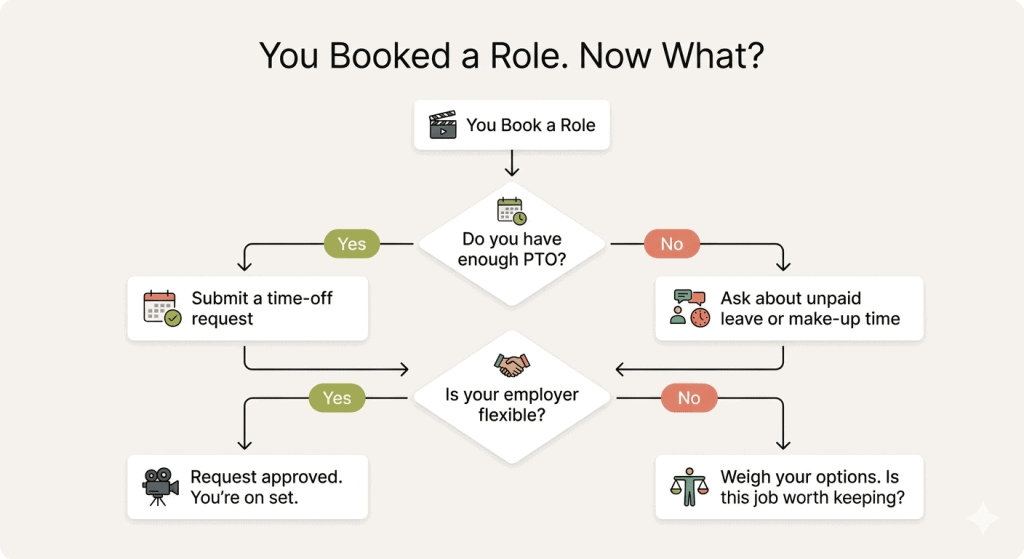
The real issue is what happens when you book something. Will you have the ability to take time off during those shooting dates without risking your day job?
That means an actor-friendly employer is really just an employer with a flexible, reasonable approach to time off and PTO.
Start Before the Interview: Vetting Jobs While You Search
The vetting process doesn’t start when you walk into an interview room. It starts the moment you open a job listing.

Industries that tend to offer more flexibility:
Tech companies and startups often run on results-oriented cultures. They care more about output than hours logged, which usually translates into a more relaxed approach to time off.
Creative agencies, nonprofits, and higher education institutions tend to operate similarly.
Remote-first companies are worth prioritizing, too. If a company has already built infrastructure around people working from different locations, they’re usually more comfortable with schedule flexibility in general.
Freelance and contract roles are also worth considering. They’re not always stable long-term, but they often come with the built-in understanding that you have other commitments.
Industries that tend to be more rigid:
Finance and banking, law firms, clinical healthcare roles, retail, hospitality, and most government positions tend to have strict attendance expectations and less flexibility around unplanned time off.
That doesn’t mean every company in these industries is a dead end. But you’ll need to work harder to vet them, and you’ll want to see clear evidence of flexibility before you commit.
What to look for in a job posting:

Pay attention to the language. Phrases like “flexible work environment,” “remote or hybrid options,” “results-driven culture,” or “generous PTO” are good signs.
Vague language like “fast-paced environment” or “must be available as needed” is worth pausing on.
Also check whether they list specific PTO amounts. Companies that are proud of their leave policies tend to mention them upfront.
Companies that bury or omit that information sometimes do so for a reason.
Pre-interview research worth doing:
Before you apply, spend ten minutes on Glassdoor and filter reviews specifically for comments about work-life balance and management flexibility. Look at employee profiles on LinkedIn.
Do people at this company list side projects, freelance work, or creative pursuits? That’s a decent signal that the culture tolerates outside commitments.
Finally, check the company’s own About or Culture page. The way a company talks about itself usually tells you something about what they actually value.
Green Flags to Look For in the Interview

Once you’re in the room (or on Zoom), you’re looking for confirmation of what your research suggested. A few things to watch for.
The interviewer mentions PTO or flexibility without you asking. That’s a great sign. It means they’re used to talking about it, which usually means people actually use it.
The team seems to have lives outside of work. If your interviewer mentions hobbies, side projects, or the fact that they leave at 5pm, that tells you something real about the culture.
They answer your flexibility questions directly and without hesitation. We’ll get to the specific questions in a moment, but how someone responds to a question about time off often tells you more than what they actually say.
Openness and specificity are good. Vagueness and deflection are not. Remote or hybrid options are on the table.
Even if you don’t need them every day, companies with flexible location policies tend to have flexible cultures overall.
Red Flags That Should Make You Think Twice
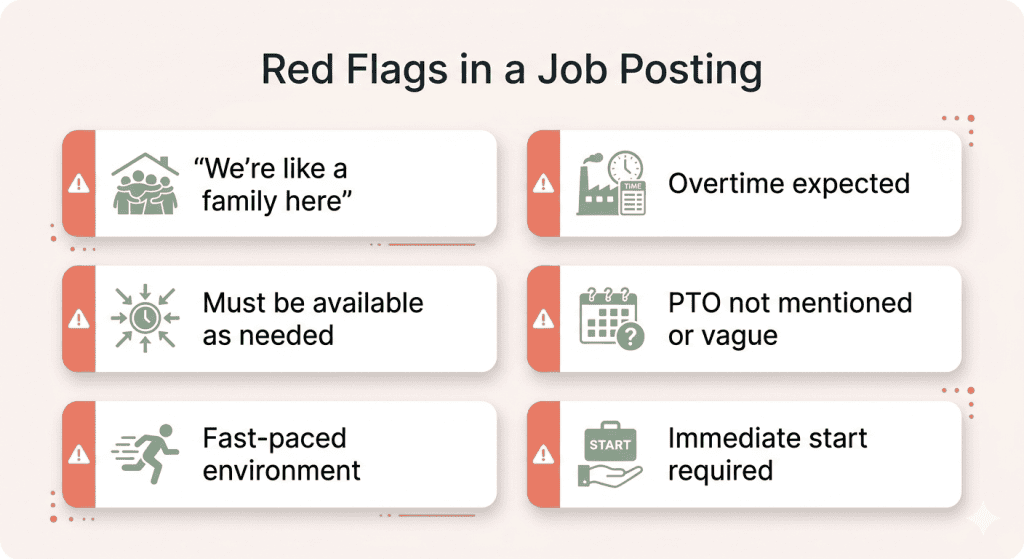
Some of these are obvious. Some are easy to miss when you’re excited about an opportunity.
“We’re like a family here.” This phrase almost always means the company expects more than a standard professional commitment from you. Families don’t clock out at 5pm. Be cautious.
Accrual-only PTO with a long waiting period. If you can’t touch your PTO for the first six months, and it accrues slowly after that, you’re going to have very little room to maneuver if you book something in your first year.
Mandatory overtime is baked into the job description. If the listing mentions it as a regular expectation rather than a rare exception, take that seriously.
Evasive or uncomfortable answers when you ask about flexibility. If a simple question about work-life balance makes the interviewer shift in their seat, that’s your answer.
High turnover. A lot of job postings for the same role over a short period, or Glassdoor reviews that mention burnout and long hours, usually indicate a culture that demands a lot and gives back a little.
Questions to Ask in the Interview
The goal here is to surface the information you need without making it weird. You’re not announcing anything about yourself. You’re just asking about team culture, the same way any thoughtful candidate would.
These four questions do the job well:
"How does the team typically handle it when someone needs to take time off for a personal commitment, especially on shorter notice?"
"What's the culture like around actually using PTO? Do people tend to take their full allowance?"
"Is there flexibility in how and when work gets done day-to-day, or is it pretty structured?"
"What does work-life balance actually look like on this team? I'd love to hear how people describe it."
Pay attention to how enthusiastically and specifically they answer. A good employer will have good, concrete answers ready. A rigid one will hedge, generalize, or pivot.
Should You Disclose Your Acting Career?
This is the question many actors stress about, and the honest answer is: it depends on where you are in your career.
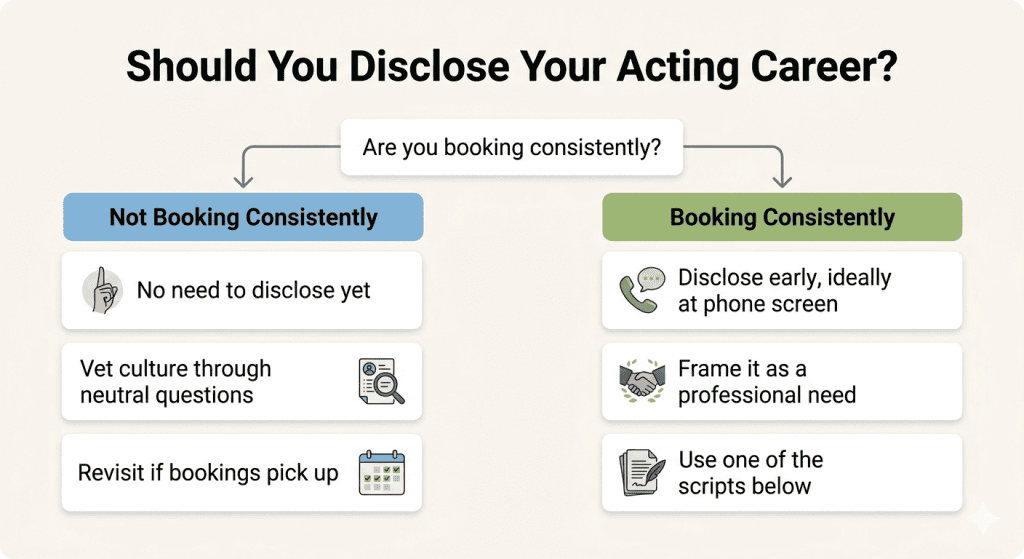
If You’re Not Booking Consistently Yet:
You probably don’t need to bring it up at all. Your time-off needs right now aren’t significantly different from those of any other employee.
Focus on vetting the culture through neutral questions, get the job, and prove yourself. You can always revisit the conversation later if your booking frequency changes.
Disclosing before you have a real, practical reason to do so can create unnecessary bias before you’ve had a chance to show what you’re worth. There’s no upside to that.
If You Are Booking Consistently:
Here it makes sense to disclose, and sooner is better. A lot of companies start the hiring process with a recruiter phone screen. That’s actually a reasonable place to raise it. Not as a big announcement, just as a straightforward logistical question.
There’s no point investing time in three rounds of interviews only to find out the company can’t accommodate you.
Frame it calmly and professionally. You’re not asking for special treatment. You’re doing what any reasonable professional would do: flagging a relevant need before both sides commit.
Here are 5 Scripts to use to Disclose Your Acting Career
Keep in mind that every employer and every conversation is different. These scripts are starting points, not guarantees.
Use them as a framework to find your own words, and make sure you feel confident and natural saying whatever you choose.
How you carry yourself in that moment matters just as much as the words themselves.
Script 1 (Phone screen, lightest touch):
 "Before we go further, I want to mention that I occasionally have professional commitments that require me to take planned time off, sometimes a few days, occasionally a week or two. Is that something this role could typically accommodate?"
Script 2 (Phone screen, more direct):
 "I want to be upfront: I work in film and TV on a freelance basis alongside my full-time work. It doesn't affect my day-to-day availability, but I do need to take time off when projects come up. Is flexibility around planned leave something this team can work with?"
Script 3 (Later stage interview, after you sense a strong fit):
 "I'd love to ask about leave flexibility. I have an outside professional pursuit that books sporadically but requires me to take time off when it does, usually with some advance notice. How has the team handled situations like that in the past?"
Script 4 (Post-offer negotiation, safest timing):
 "I'm really excited about this offer. One thing I'd want to confirm before accepting: I occasionally take on acting projects that require short-term leave. Is that something we could build into the arrangement, either through PTO, unpaid leave, or flexibility as needed?"
Script 5 (If they ask follow-up questions):
 "I work as an actor, primarily TV and film. It doesn't interfere with my day-to-day performance, but when I book a role, I need to be on set. I've always been upfront about it and it's never been an issue with employers who value flexibility. I just want to make sure we're aligned before moving forward."
The Online Presence Wildcard
Here’s something a lot of actors don’t think about. If you have a visible public profile online, an IMDb page, casting site listings, and a headshot that shows up when someone Googles your name, there’s a real chance a potential employer already knows you’re an actor before you walk in.
Here’s what you see when you Google my name, “Joel Kawira”. Any potential employer would instantly see my acting shenanigans!
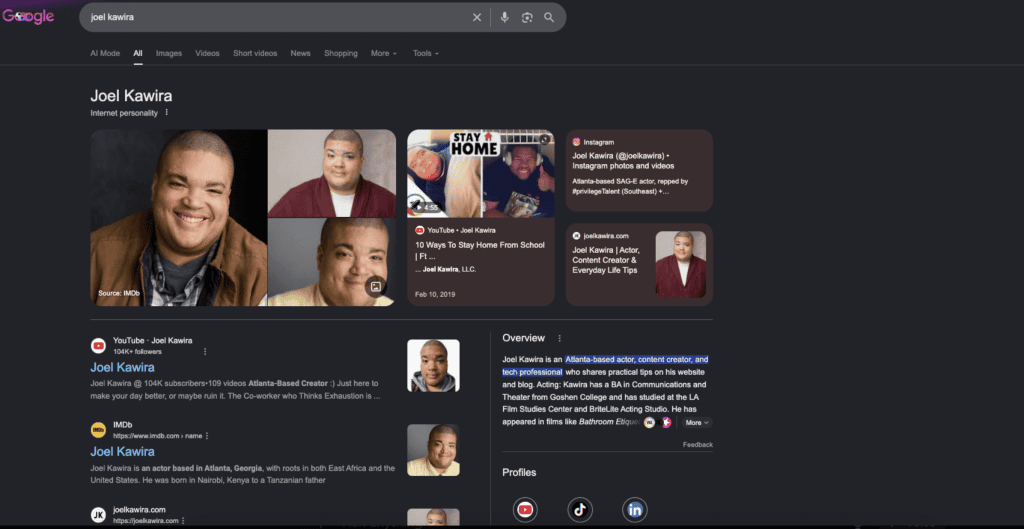
Companies Google candidates. It’s standard practice. And if your name surfaces in acting profiles, they’ve either already formed an opinion or they’re waiting to see if you bring it up.
This actually makes a case for proactive disclosure. Getting ahead of it on your own terms, with calm, professional framing, is almost always better than being asked about it after the fact.
The latter puts you on the defensive. The former signals confidence and transparency.
It’s also worth taking a few minutes to audit what comes up when you search your own name. Make sure your public profiles look professional and intentional, not like an afterthought.
A polished online presence can work in your favor. It signals that you take your craft seriously, which a good employer will respect even if acting isn’t their world.
Vet Them Like They’re Vetting You

Here’s the mindset shift that makes all of this easier. You are not just a candidate hoping to get picked. You are also someone evaluating whether this company deserves your time, your skills, and your commitment.
Knowing how to vet an employer as an actor means going into every job search with that energy. Research before you apply.
Ask the right questions in the interview. Read the room honestly. And if something feels off, trust that feeling.
The right employer is out there. They exist in every industry, at every pay grade. You just have to know what to look for before you say yes.
Frequently Asked Questions
How do I know if an employer is actor-friendly before the interview?
Start with the job posting itself. Look for language around flexibility, remote or hybrid options, and generous PTO. Then check Glassdoor reviews filtered for work-life balance, and scan LinkedIn to see if current employees list side projects or creative work. Companies that support outside pursuits tend to attract people who have them.
What questions should I ask an employer as an actor?
Ask about PTO culture, how the team handles short-notice personal commitments, and whether there’s flexibility in how work gets done day-to-day. Keep the questions neutral. You’re asking about team culture, not announcing anything about yourself. How the interviewer responds tells you as much as what they actually say.
When is the best time to disclose acting during the hiring process?
If you’ve decided to disclose, earlier is generally better. Raising it at the recruiter phone screen saves everyone time if the company can’t accommodate your needs. The exception is waiting until after a verbal offer if you want maximum leverage, but that comes with the risk of the offer being pulled if flexibility is a dealbreaker for them.
Should I tell an employer I’m an actor during the interview?
It depends on how consistently you’re booking work. If you’re not booking regularly yet, you likely don’t need to bring it up at all. If you are booking consistently and need to take planned time off for roles, it’s worth disclosing early, ideally at the phone screen stage, so you don’t waste time on opportunities that won’t work for your career.
What are the red flags that an employer won’t support my acting career?
Watch for “we’re like a family here” culture language, accrual-only PTO with long waiting periods, mandatory overtime expectations in the job description, and evasive answers when you ask about flexibility. High turnover and burnout mentions in Glassdoor reviews are also worth taking seriously.