You just got sides for an audition tomorrow, or a self-tape due in two days. Now you need to know those words well enough to forget about them and actually act.
Whether it is a short audition scene, a monologue, or a full role, memorizing lines is a skill, not a talent. Some people seem to pick it up instantly, but most actors rely on simple, repeatable techniques. Here are five that work, and how to combine them when you are short on time.
Before any technique, read the whole scene a few times without trying to memorize anything. Ask: who am I talking to, what do I want, and what is in my way? This quick script analysis gives you the objective and subtext behind every beat.
Lines stick much faster when you know why your character says them. When you understand the thought behind each line, the next line becomes the obvious response instead of a random string of words. If you want to go deeper, our guide to acting techniques explained covers how different methods approach a script.
1. The First-Letter Method
Write out each of your lines using only the first letter of every word, keeping the punctuation. For example:
"I told you I would be here by six." becomes "I t y I w b h b s."
Then read from the letters and say the full line out loud. Your brain has to fill in each word, which is active recall, and active recall builds memory far faster than rereading the page. Memory researchers call this the testing effect.
Check against the script after each pass and fix any words you paraphrased. Casting and writers notice when lines change.
2. Record Your Cues and Leave Gaps
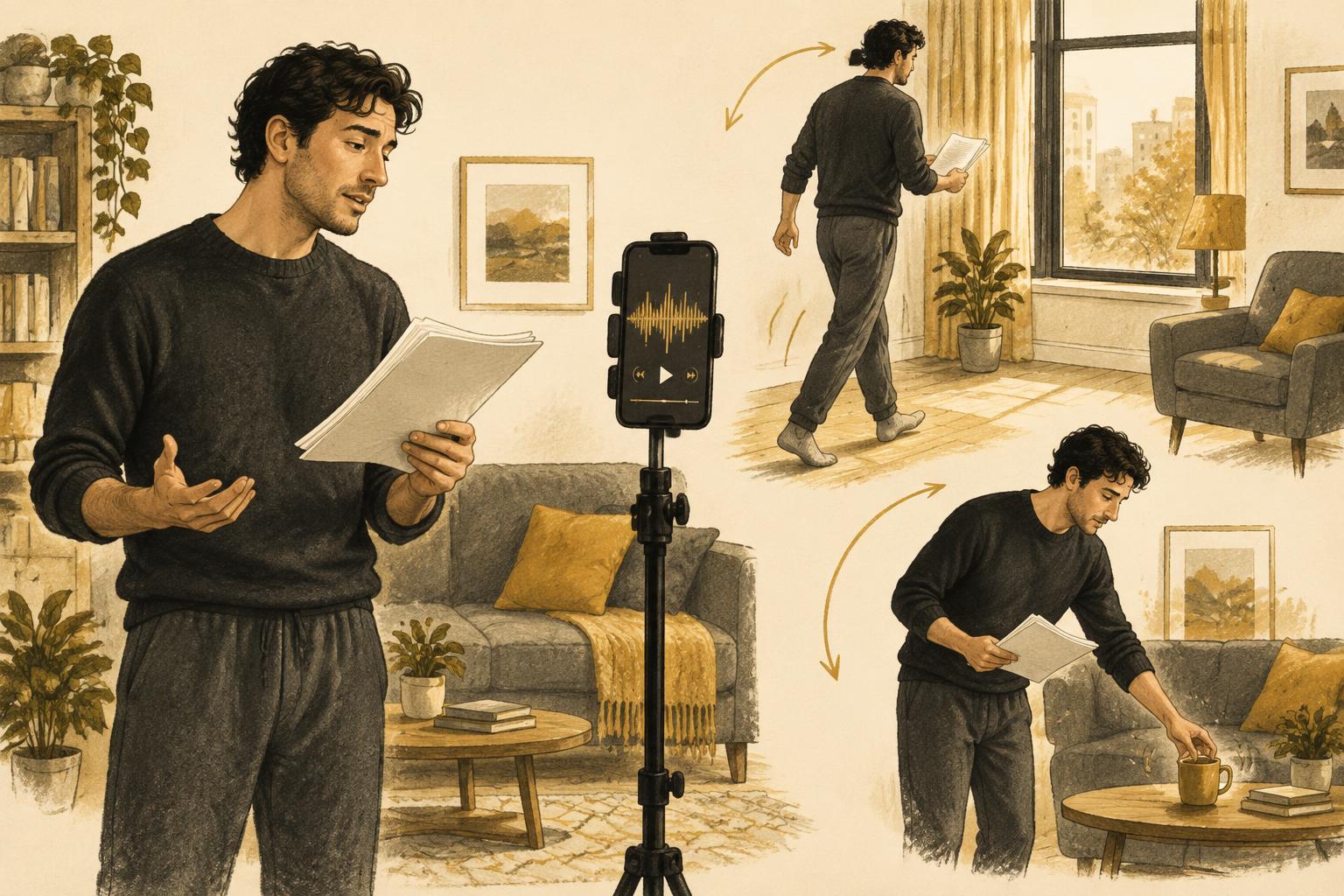
Record the other character's lines on your phone, leaving silence where your lines go. Play it back and speak your lines into the gaps.
This trains you to respond to what you hear instead of waiting to see your line on a page, which is exactly what happens in the room, on a cold read, or on set. You can practice while walking, cooking or commuting.
Make a second version with your lines included to listen to passively, then switch back to the gap version to test yourself.
3. Attach Lines to Movement
Stand up and move through the scene. Pick up a cup on one line, cross to a window on another, sit on a third. Even for a self-tape where you will mostly stand still, rehearsing with movement helps.
Your body becomes part of the memory. When each line is tied to a physical action or a spot in the room, you have more than one path back to the words. This kind of muscle memory also keeps your delivery from sounding robotic.
4. Run Lines With a Reader or an App
Nothing replaces saying the scene with another person. Ask a friend, a classmate or a scene partner (or someone from an online acting class) to read with you and correct you when you drift from the text.
If no one is available, rehearsal apps and online reader services can feed you cues on demand. See what makes a great virtual audition reader, our WeAudition review, and these AI tools for actors that can run lines with you. Running the scene at full pace, several times, is the quickest way to find the spots where you still hesitate.
5. Review Right Before Sleep
Run your lines one last time before bed, then test yourself in the morning before looking at the script. Sleep helps the brain consolidate memory, and you will often find lines feel steadier the next day.
If you have even one night before your audition or tape, use it. Cramming in a single sitting usually holds up worse under pressure. Short sessions spread over time, called spaced repetition, beat one long session, even when you are learning lines last minute.
A Quick Plan When Time Is Short
First 15 minutes: read the scene for meaning, not memory.
Next 30 minutes: first-letter method, line by line, then the full scene.
Next 20 minutes: record your cues and run the gap version until you stop pausing.
Then: stand up and run it with movement or a reader.
Before bed: one calm pass, then test yourself in the morning.
Common Mistakes to Avoid
Memorizing a flat line reading, then struggling to change it when given an adjustment.
Only practicing silently in your head instead of out loud.
Skipping your cues, so you know your lines but not when to say them.
Paraphrasing without noticing, especially on short or similar lines.
Once you are off book, put the work on camera. Bring these tools for actors on set and keep your sides handy for any last changes.
Questions
Frequently Asked Questions
Free 2-minute quiz
What type does casting see in you?
Answer a few quick questions to discover your castable archetypes, roles to target, and headshot wardrobe ideas. Get your full report by email.